
5 Career Mistakes That Keep PMs Stuck as Task Trackers
How to stop being treated like a glorified admin without changing jobs.

A PM posted this on Reddit last week.
“On my worst days, I feel useless. Timelines are just paper exercises, I ‘just’ follow-up with people, schedule and lead meetings. I feel like a glorified admin.” — r/projectmanagement
It got hundreds of upvotes. Dozens of replies. All saying the same thing. “Same here.” “This is me.” “I could have written this myself.”
That post is not unusual. It’s the most common career experience in project management.
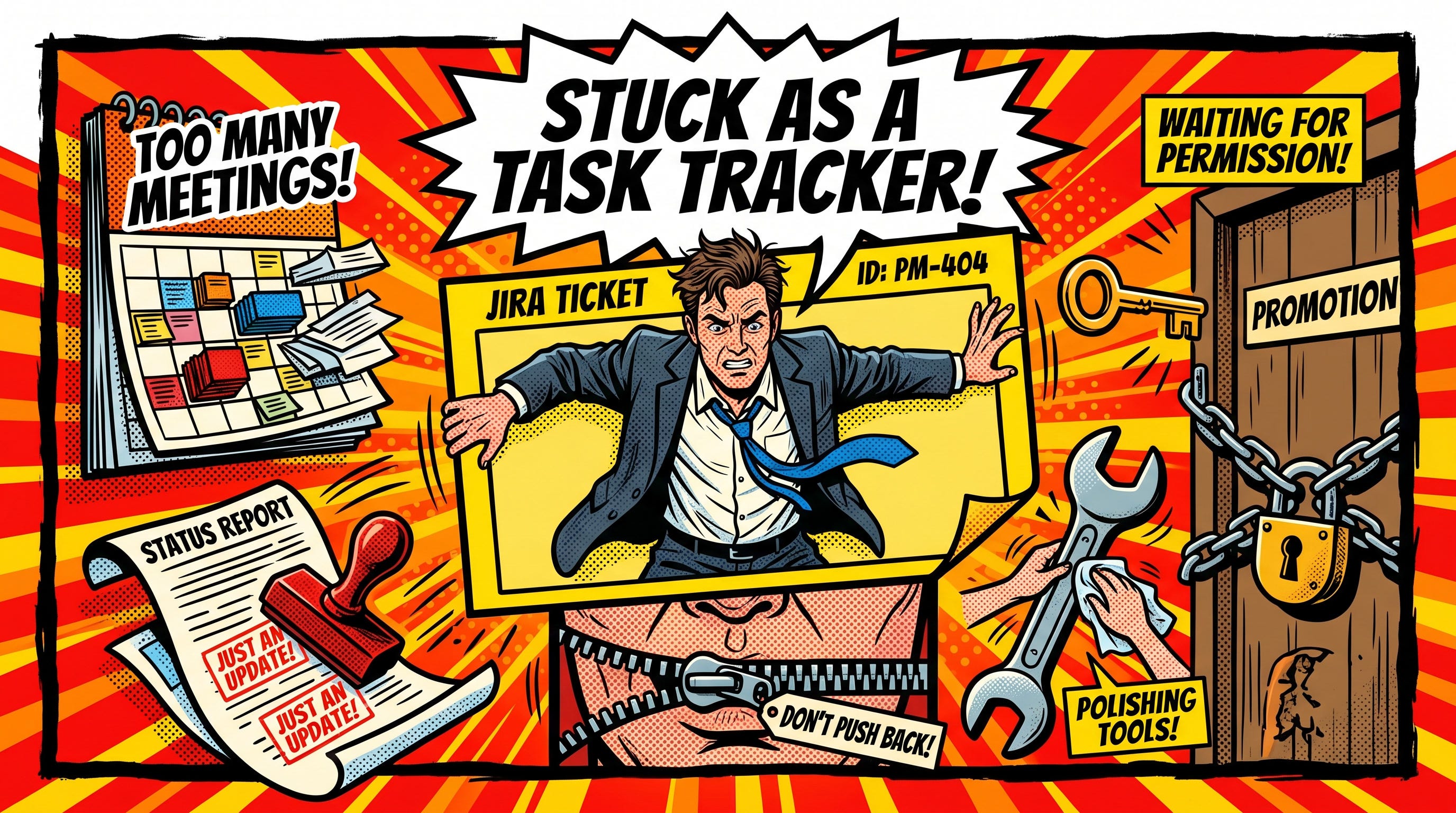
The trap is structural, not personal.
Most PMs assume they’re stuck because they lack a skill. They look for the next certification. The next framework. The next tool. None of it works.
The thing keeping them stuck is not a skill gap. It’s a pattern of small, invisible career habits.
The trap closes quietly. You take the meeting. You send the status. You don’t ask questions. You learn the tool. You wait. After a year, the role has shrunk to fit the smallest version of you.
You feel useless. You don’t know why. You blame yourself.
The five mistakes below are what’s actually happening. If you stop making them, your role will get bigger.
The Tuesday I caught myself.
Five years into agency life, I was working on a website rebuild for an insurance company. Big budget. Good team. I was the least experienced person - eager to learn.
One day, I noticed something. I had spent the whole time moving Jira tickets between columns. Not solving a problem. Not making a decision. Not driving anything. Just shifting rectangles on a screen.
That was when I realised I had shift my approach. The team didn’t need someone to manage the project. They needed someone to have the difficult conversation with the client about scope. Nobody was doing it. Including me.
I closed Jira and rocked up to my Account Directors desk. Then had a conversation about how I could add more value - it changed everything. Because I stopped waiting.
Stop doing this 👇
1. Saying yes to every meeting.
Attendance is not contribution. PMs confuse the two because meetings feel productive. They aren’t.
If you can’t name what the outcome needs to be, send a one-line update and skip it. The people who lead don’t sit in every meeting. They pick the three that matter and prepare properly for those.
2. Treating status updates as your main value-add.
If your weekly summary is the most senior thing you produce, you’ve capped your career.
Status reports are table stakes. The actual job is making decisions easier for the people around you. Stop sending updates. Start sending recommendations.
3. Never pushing back because you think it’s not your place.
The PMs who grow are the ones who say “I think we’re doing the wrong thing here.” Politely. With evidence AND a solution.
The PMs who stay stuck nod, take the action, and complain about it on Reddit eighteen months later. You are paid to flag the wrong call and make the right one.
4. Learning tools instead of learning to think strategically.
Mastering Jira will not make you senior. Reading books on how your team do their jobs will.
The PMs who jump levels can articulate the trade-off, name the risk, and read the room. Tools are the floor. Value-added thinking is the ceiling.
5. Waiting for permission to lead.
Nobody is coming to tap you on the shoulder.
The PMs who get promoted started acting like leads months before the title. They ran the kickoff nobody owned. They wrote the doc that didn’t exist. They recommended an approach to solving a problem that wasn’t directly theirs.
One note on the messy reality.
These tips sound easy on an email. In practice, they’re harder.
Some clients don’t like pushback. Some bosses don’t promote regardless of effort. Some weeks you’re drowning in deadlines
Don’t be afraid to speak up and get what you want.
Speak soon,
Tim