
How to Solve Your Biggest Problems by Going for a Walk
Why your best thinking will never happen at your desk.

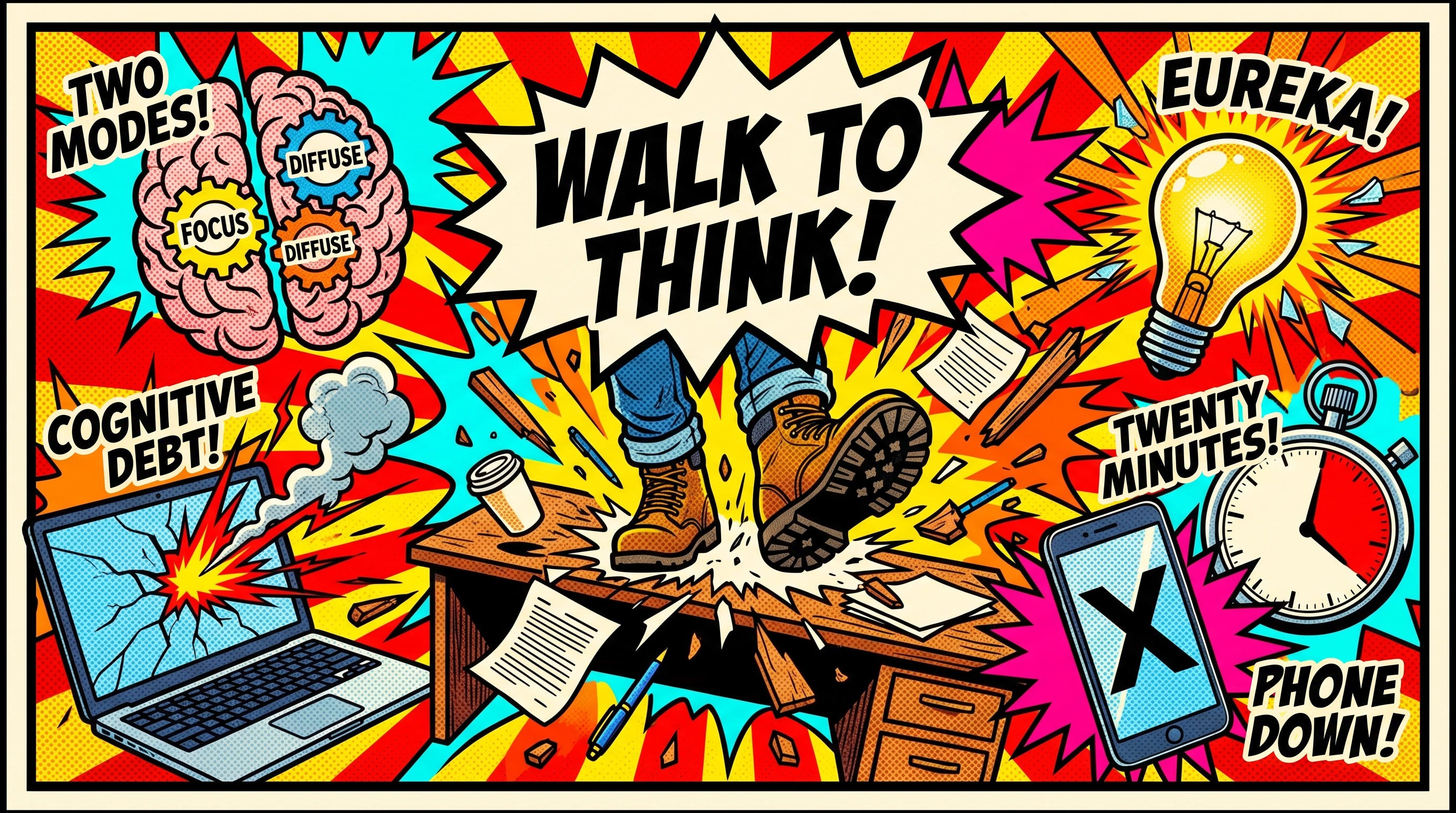
I’ve solved more problems on a walk than I’ve ever solved at my desk.
Most of the answers I’ve actually needed — the awkward client email I couldn’t word, the project plan that wasn’t sitting right, the decision I’d been putting off for a fortnight — didn’t arrive while I was staring at the screen. They turned up about twenty minutes into a walk with the dog. Sometimes on a run. Almost never sitting down.
The desk is where I process. Not where I solve.
Your brain has two gears.
Most of your day is spent in the wrong one.
Focus mode is narrow. Deliberate. It’s the gear you use when you’re pushing at a problem inside a frame you already understand.
Diffuse mode is the opposite. Loose. Associative. The mode where the brain stitches unrelated things together and finds the answer sideways.
Barbara Oakley made this distinction famous through Learning How to Learn — one of the most popular online courses ever made. Her point is simple. Hard problems get solved in diffuse mode. Not focus mode.
You can stare at a piece of work for two hours and miss the obvious thing. Then you stand up, walk to the kettle, and the answer arrives before you sit back down. That’s not a coincidence. That’s your brain finally getting to do the thing it’s actually built for.
A 2014 Stanford study tested this four different ways. People came up with 60% more creative ideas on average when they were walking compared to sitting. Not 6%. Sixty.
You’re not slacking when you walk. You’re using the part of your brain that solves the problems your desk can’t.
The screen is making this worse.
The more you stay at the desk, the less your brain works.
Last year, MIT’s Media Lab ran an EEG study on people writing essays. Three groups: one with ChatGPT, one with a search engine, one with nothing. The results were clear. The brain-only group showed the strongest neural engagement. The ChatGPT group showed the weakest. The researchers coined a term for what they were seeing.
Cognitive debt.
The point isn’t to ditch the tools. The point is what happens when you don’t step away from them.
Look at your day honestly. Screens stacked on screens. AI that can finish your sentences. Slack and Teams channels that train you to react instead of think. A calendar that doesn’t leave a single hour for anything other than meetings. The thing that used to give your brain breathing room — the gap between tasks — is gone. Filled with autocomplete.
The walk is the gap. Without it, the brain never gets to do the work that actually makes you good.
How to actually do this.
Three rules. They sound simple. Most people ignore all three.
Walk before the hard thing, not after.
When you’ve got a meeting where you actually need to think — a difficult conversation, a decision you’ve been ducking, a problem that’s been on your mind for days — take twenty minutes first. Walk, then sit down. Don’t reverse it. The point is to arrive at the desk with the answer, not leave looking for it.
Bonus: take the dog. He doesn’t care about your inbox!
2. Phone in pocket. No podcasts.
Diffuse mode needs silence. Not stimulus. Music with lyrics, podcasts, calls — they all pull you back into focus mode and waste the walk. The brain needs the boredom. That’s actually what triggers it.
3. Bring the problem. Then let it go.
Frame the question before you leave the desk. Walk out with it in your head (don’t try to solve it). Then stop pushing. The brain does the work in the background. The answer arrives sideways, usually around minute fifteen.
The first walk feels like wasted time. By the third, you’ll notice you’ve solved things you couldn’t crack at the screen. By the tenth, you’ll start guarding the time on your calendar like it’s a meeting. Which is what it is.
The job is to think.
Whatever you do for a living, the thing you’re actually paid for is judgment.
The plan is downstream of it. The email is downstream. The decision is downstream. Every output you produce is the visible end of an invisible process — the actual thinking — that has to happen somewhere.
If the only place that ever happens is at your desk, in front of a tool that finishes your sentences, you’re not thinking. You’re typing.
And typing is the easiest thing in the world to replace.
The people who pull ahead this year will be the ones whose best ideas didn’t come from a prompt box. They came from somewhere quieter.
Walk. Cos that’s where the work actually gets done.
And, if this was useful, forward it to someone stuck in firefighting mode. They need this more than anyone.
Speak soon, Tim